|
Flow Research
has been covering vortex flowmeters since our first study in 2001. We
are now working on a new study, The World Market for Vortex Flowmeters,
8th Edition. This study will focus especially on multivariable vortex meters
and on the extent to which they integrate pressure and temperature sensors in
their calculation of mass flow. Mass flow is becoming more important as
end-users measure steam and find increased need to measure natural gas and other
gases.
Vortex
flowmeters, introduced to the market in 1969, are versatile, reliable and
accurate in measuring liquids, gases, and steam at a competitive price -- and
with equal ease. They are widely used for steam flow measurement and can handle
the high temperatures of both saturated and superheated steam.
Many vortex
meters today offer accuracy better than one percent, depending on the fluid and
application. They also have very favorable costs of acquisition,
commissioning and ownership.
With more
suppliers entering the market and a growing demand for gas flow measurement, we
believe vortex flowmeters are uniquely positioned for strong growth.
Since vortex
flowmeters were first introduced to the market, the number of worldwide
suppliers has grown to more than 50 and many changes have taken place in the
market. Today there are a wide variety of choices for customers to make when
specifying or purchasing vortex flowmeters. Technical innovations include
anti-vibration software and electronics, multivariable flowmeters, reduced bore
meters, plastic vortex flowmeters, and much more.
This
study examines:
-
Market
growth factors
-
Effects
of the API's adoption of a custody transfer standard on vortex sales
-
Growth
in the use of multivariable flowmeters
-
Line
sizes for vortex flowmeter applications
-
Use
of vortex meters in steam applications
-
Growing
trend towards dual sensor vortex meters
-
Importance
of reducer vortex meters
-
New
product and technology developments
-
Growth
strategies for vortex flowmeter suppliers
What’s new
Despite what
has been slow growth in the vortex flowmeter market, there are signs that this
flowmeter is breaking out of its slump. One sign is the major product
enhancements that have occurred in the past five years.
In addition,
the American Petroleum Institute’s approval of its API 14.12 standard for
using vortex flowmeters in single phase gas and steam custody transfer
applications has boosted market growth as suppliers develop products that
conform to the standard.
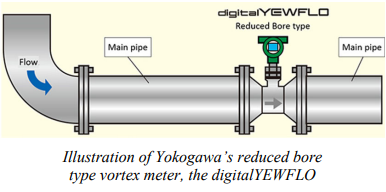
Reduced bore meters
Due to their
design, vortex flowmeters have traditionally had trouble measuring low flowrates.
Suppliers have now introduced smaller bore flowmeters that provide a stronger
signal at the point of measurement and allow the meter to more effectively and
accurately measure low flows. Past studies have found that both single-line size
and double-line size reduced bore vortex flowmeters have become increasingly
popular in the last few years.
Advantages of multivariable vortex flowmeters
Sierra
Instruments (now part of TASI Group) introduced the first multivariable vortex
flowmeter in 1997. Sierra had a marketing agreement with Jim Storer, who
invented the meter. This flowmeter included an RTD temperature sensor and a
pressure transducer. By using information from these sensors, together with
detection of vortices generated, the flowmeter can output volumetric flow,
temperature, pressure, fluid density, and mass flow. Multivariable flowmeters
measure more than one process variable, and typically use this information to
compute mass flow. This makes the flowmeter measurement more accurate in
fluctuating temperature and pressure conditions.
In
the past 10 years, a number of suppliers have also introduced multivariable
vortex flowmeters that use sensors to determine a variety of factors: volumetric
flow, temperature, pressure, fluid density, and mass flow. While somewhat
more expensive than their single-variable, volumetric counterparts,
multivariable vortex flowmeters provide significantly more information. They are
particularly attractive for steam and gas flow measurement and are contributing
to vortex flowmeter market size growth.
Other
suppliers that have introduced multivariable vortex flowmeters include include
ABB, Yokogawa, KROHNE, and Endress+Hauser.
Redundancy is increasingly important
In response
to user demands for increased reliability and certainty, manufacturers have
introduced two redundant configurations: 1) a single shedder bar with dual
sensors and 2) dual vortex meters calibrated and installed in tandem directly in
the flowstream. Although the traditional installation with a single shedder
bar and sensor still dominates the market, our study determined that users see
the value of measurement redundancy.
Vibration
Issues solved
One perennial problem with vortex flowmeters has been susceptibility to
vibration error. Vibrations in the line can cause a vortex flowmeter to falsely
generate a vortex signal, or to incorrectly read an existing vortex. Suppliers
have responded to issues surrounding vibration by implementing software and
electronics, including digital signal processing, that have reduced the
susceptibility of vortex meters to interference from vibration.
How they work
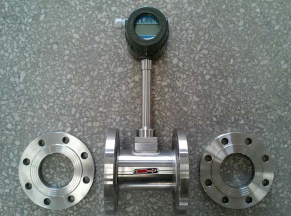
Vortex
flowmeters operate on a principle called the von Karman effect. This principle
concerns the behavior of fluids when an obstacle is placed in the path of flow.
Under the right conditions, the presence of the obstacle generates a series of
alternative vortices called the von Karman street. This phenomenon occurs in
liquid, gas, and steam, and has been observed in many diverse contexts including
cloud layers passing an island and whitewater rapids.
In vortex
flowmeters, the obstacle takes the form of an object with a broad, flat front
called a bluff body that is mounted at right angles to the flowstream.
Flow velocity is proportional to the frequency of the vortices and flowrate is
calculated by multiplying the area of the pipe times the velocity of the flow.
In order to
compute the flowrate, vortex flowmeters count the number of vortices generated
by the bluff body using a variety of techniques. The majority of vortex
flowmeters use a piezoelectric sensor to detect vortices, however some use a
capacitive or ultrasonic sensor.
Flow Research
has been covering vortex flowmeters since our first study on them in 2001. Our
latest report, The World Market for Vortex Flowmeters, 6th Edition,
shows that this useful and affordable meter is still strong and continuing to
experience steady market growth.
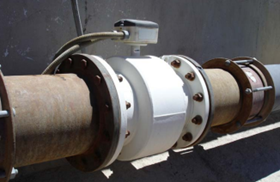 Vortex
flowmeters, introduced to the market 56 years ago, are versatile, dependable and
accurate in measuring liquids, gases, and steam at a competitive price -- and
with equal ease. They are widely used for steam flow measurement and can manage
the high temperatures of both saturated and superheated steam. Vortex
flowmeters, introduced to the market 56 years ago, are versatile, dependable and
accurate in measuring liquids, gases, and steam at a competitive price -- and
with equal ease. They are widely used for steam flow measurement and can manage
the high temperatures of both saturated and superheated steam.
Many vortex
meters today offer accuracy better than one percent, depending on the fluid and
application. They also have very favorable costs of acquisition,
commissioning, and ownership.
With more
suppliers entering the market and a growing demand for gas flow measurement, we
believe vortex flowmeters are uniquely positioned for strong growth.
Since vortex
flowmeters were first introduced to the market in 1969, the number of worldwide
suppliers has grown to at least 35 and many changes have taken place in the
market. Today there is a wide diversity of choices for customers to make when
specifying or purchasing vortex flowmeters. Technical innovations include
anti-vibration software and electronics, multivariable flowmeters, reduced bore
meters, plastic vortex flowmeters, and much more.
Advantages of multivariable vortex flowmeters
Vortek
Instruments introduced the first multivariable vortex
flowmeter in 1997. This flowmeter included an RTD temperature sensor and a
pressure transducer. By using information from these sensors, together with
detection of vortices generated, the flowmeter can output volumetric flow,
temperature, pressure, fluid density, and mass flow. Multivariable flowmeters
measure more than one process variable, and typically use this information to
compute mass flow. This makes the flowmeter measurement more accurate in
fluctuating temperature and pressure conditions.
In the past
10 years, a number of suppliers have also introduced multivariable vortex
flowmeters that use sensors to determine a variety of factors: volumetric flow,
temperature, pressure, fluid density, and mass flow. While more expensive than
their single-variable, volumetric counterparts, multivariable vortex flowmeters
provide significantly more information. They are particularly attractive for
steam and gas flow measurement and are contributing to vortex flowmeter market
size growth.
Other
suppliers that have introduced multivariable vortex flowmeters include ABB.
Yokogawa, KROHNE, and Endress+Hauser.
Previous Vortex Flowmeter Studies
The
World Market for Vortex Flowmeters, 7th Edition Previous
Study - April 2024
The World Market for Vortex Flowmeters, 6th Edition
Previous Study -
January 2019
The World Market for Vortex Flowmeters, 5th Edition
Previous Study -
December 2014
The World Market for Vortex Flowmeters, 4th Edition
Previous Study - July 2010
The World Market for Vortex
Flowmeters, 3rd Edition
Provides historical perspective
The World Market for Vortex Flowmeters, 2nd Edition
Provides historical perspective
The World Market for Vortex Flowmeters, 1st Edition
Provides historical perspective
|